
 Español
 Nederlands
 Deutsch
 Français
 Русский
Periodontics and gum treatment in Altea
General dentistry
Periodontics
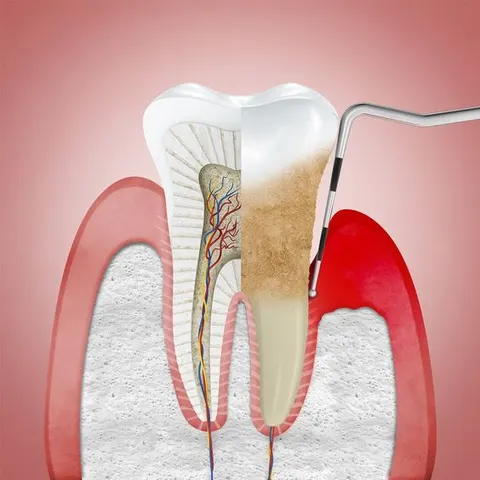
Gingivitis is a problem that affects the gums, the soft tissue around the teeth. It is a form of gum disease, but the least destructive one: it does not cause irreversible damage or changes to the tissues that support the teeth. It is usually noticed when the gums bleed on their own while you brush or eat.
Gingivitis and periodontitis
If gingivitis is not treated, it can progress to periodontitis, a more advanced form of gum disease. At this stage the inflammation affects the bone and tissues that hold the tooth in place: pockets form between the gum and the tooth, the gums recede and the teeth can become loose and may even be lost. Periodontitis does not heal on its own, but it can be controlled with treatment and maintenance.
Warning signs
- Gums that bleed when you brush or eat.
- Red, swollen or receding gums.
- Persistent bad breath.
- Teeth that look longer, are spreading apart or feel loose.
- Sensitivity to cold at the neck of the teeth.
How we treat it
- Diagnosis: we measure the depth of the pockets around each tooth (periodontal charting) and take X-rays to assess the bone.
- Deep cleaning (scaling and root planing): we remove the tartar and bacteria beneath the gum, under local anaesthetic.
- Re-evaluation: a few weeks later we check how your gums have responded.
- Periodontal maintenance: regular cleanings and check-ups so the disease does not progress again.
Prevention
Good brushing, cleaning between your teeth and a regular professional teeth cleaning are the best prevention. Smoking, poorly controlled diabetes and stress increase the risk, so in those cases check-ups are even more important. Healthy gums are also essential before having implants or orthodontic treatment.
Gums and implants
Before placing implants or starting orthodontic treatment we check that your gums are healthy, because gum disease can compromise the result. If you already have implants, the tissues around them can also become inflamed: that is why check-ups and regular cleanings are just as important as with natural teeth.
Periodontics and gum treatment in Altea, near Benidorm, Calpe and l'Alfàs del Pi
Our clinic is in Altea la Vella, at Crta. Callosa 21, a few minutes from Altea, l'Alfàs del Pi, Benidorm, Calpe, La Nucia, Polop, and Callosa d'en Sarrià. There is parking for our patients nearby, and we can help you in English, Dutch, German, French and Spanish. Call us on +34 966 88 48 95 or book online.
Coming from the UK or Ireland? Dental treatment in Spain
Many of our patients spend part of the year on the Costa Blanca or travel to Altea for their treatment. Wherever possible, we arrange your appointments around the dates of your stay.
Your first visit is always an assessment at the clinic, with a 3D CT scan if needed. After that you receive a clear treatment plan and a fixed quote, so you know exactly where you stand before you decide.
We speak English: you can ask all your questions in your own language.
Frequently asked questions
Is it normal for my gums to bleed?
No. Bleeding is the most common sign of inflamed gums. If it happens often, it is worth having a check-up: at the gingivitis stage it can be resolved with a cleaning and better oral hygiene.
Does scaling and root planing hurt?
It is done under local anaesthetic, so you should not feel pain during the treatment. Afterwards there may be some sensitivity for a few days.
Can periodontitis be cured?
Bone that has already been lost does not grow back, but periodontitis can be halted and kept stable with treatment and regular maintenance, so you can keep your teeth.
How often is periodontal maintenance needed?
It depends on each case, but it is usually every three to six months. At each visit we check your gums and clean the areas your toothbrush cannot reach.
Book an appointment for an assessment
This treatment requires an assessment at the clinic first.