
 Español
 Nederlands
 Deutsch
 Français
 Русский
Cavities and fillings in Altea
General dentistry
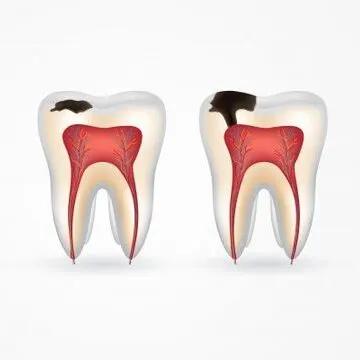
Tooth decay
Tooth decay is the destruction of the tooth's tissues by acids produced by the bacteria in the plaque that builds up on the teeth. Today we use minimally invasive techniques, removing the affected tissue and rebuilding the tooth with aesthetic materials.
If tooth decay is not treated, it can cause pain, infection and even the loss of the tooth.
Symptoms of tooth decay
At first, decay does not usually hurt, which is why it is important to detect it at check-ups. As it progresses, you may notice:
- Sensitivity to cold, heat or sweet things.
- White, brown or black spots on the tooth.
- A hole or rough patch you can feel with your tongue.
- Pain when chewing or spontaneous pain, when the decay gets close to the nerve.
How we treat it: the filling
- Diagnosis: examination and, if needed, X-rays to see how far the decay has spread.
- Local anaesthetic, so the treatment is comfortable.
- Removing the decay: we remove only the damaged tissue and keep the healthy tooth.
- Rebuilding: we fill the tooth with tooth-coloured composite and restore its shape.
- Adjusting and polishing: we check your bite and polish the filling.
If the decay is very deep and has reached the nerve, root canal treatment may be needed before the tooth is rebuilt. If a lot of the tooth has been lost, we consider an inlay or a crown.
How to prevent tooth decay
- Brush at least twice a day with fluoride toothpaste.
- Clean between your teeth with floss or interdental brushes.
- Cut down on sugar and acidic drinks, especially between meals.
- Have regular check-ups and cleanings.
Tooth decay in children
Baby teeth also decay, and faster than adult teeth. Treating them is important: they hold the space for the teeth that come after them and prevent pain and infection. Check-ups from an early age, a good brushing technique and limiting sweets between meals are the best prevention.
Cavities and fillings in Altea, near Benidorm, Calpe and l'Alfàs del Pi
Our clinic is in Altea la Vella, at Crta. Callosa 21, a few minutes from Altea, l'Alfàs del Pi, Benidorm, Calpe, La Nucia, Polop, and Callosa d'en Sarrià. There is parking for our patients nearby, and we can help you in English, Dutch, German, French and Spanish. Call us on +34 966 88 48 95 or book online.
Coming from the UK or Ireland? Dental treatment in Spain
Many of our patients spend part of the year on the Costa Blanca or travel to Altea for their treatment. Wherever possible, we arrange your appointments around the dates of your stay.
Your first visit is always an assessment at the clinic, with a 3D CT scan if needed. After that you receive a clear treatment plan and a fixed quote, so you know exactly where you stand before you decide.
We speak English: you can ask all your questions in your own language.
Frequently asked questions
Does a filling hurt?
We use local anaesthetic, so you should not feel pain during the filling. When the anaesthetic wears off there may be some sensitivity for a few days.
Can I eat after a filling?
Composite fillings harden straight away, but it is best to wait until the anaesthetic has worn off so you do not bite your tongue or cheek.
Can old amalgam fillings be replaced?
Yes, if they are worn or for cosmetic reasons. At your check-up we assess their condition and tell you whether it is worth replacing them with composite.
How long does a filling last?
A well-made, well-cared-for composite filling lasts for many years. At check-ups we look at its condition and, if it wears or leaks, we repair or replace it.
Book an appointment for an assessment
This treatment requires an assessment at the clinic first.